
Is Syncopation Sinful? A Reformed Theology of Music Outside Worship
by Dr. C. Matthew McMahon
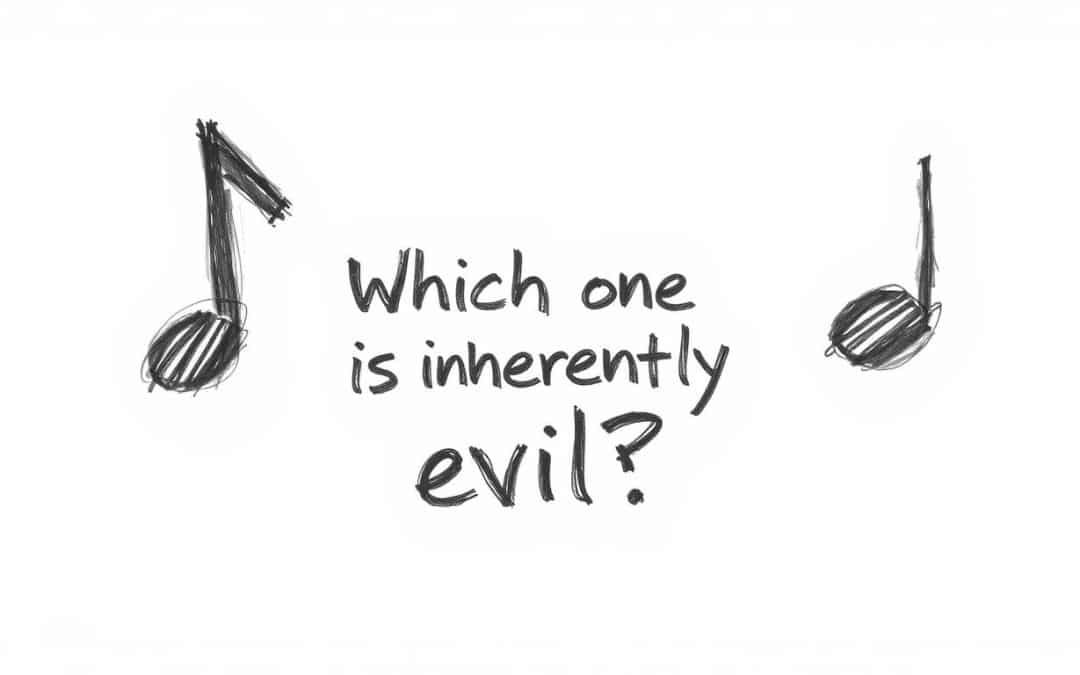
Every few weeks, as it pertains to the creation of music and content for “Reformed Music” a strange argument resurfaces because people are emotionally arguing rather than biblically thinking: Syncopated beats are worldly, sinful, or inherently immoral. On a basic level, syncopation is placing rhythmic stresses or accents on weak beats or off-beats, creating a disruption in the regular flow of rhythm. (Think, punk, certain kinds of rock, even certain types of dub-step country, etc.)
This is not a theological argument. It shows how obtuse “Reformed” Christians can be with just enough knowledge to be “dangerous.” This is a category error so elementary that even the children of the Puritans would have rebuked it. It attaches moral guilt to a circumstance, which is the very error Scripture and the Westminster Standards forbid. Let us dismantle it thoroughly, and in doing so, clarify a biblically faithful theology of music outside public worship (or any artistic expression).
- Sin never arises from circumstances but from the moral nature of an action.
A syncopated beat is no more sinful in itself than:
- a minor key
- a loud voice
- a quiet voice
- a fast tempo
- a slow tempo
- a single note
- multiple notes in a particular order.
These are accidents—circumstances—neither moral nor immoral in themselves.
“Unto the pure all things are pure.” (Titus 1:15)
Moral categories require moral content.
If rhythm itself were sinful, then:
- the timbrels of Miriam (Ex. 15:20)
- the dancing of David (2 Sam. 6:14)
- the lively praise of Psalm 150
…were sinful as well.
That collapses such obtuse arguments instantly.
- A syncopated heartbeat? A syncopated way of walking? Then what exactly are we condemning?
Human heartbeat rhythms contain natural syncopation.
Human walking patterns contain natural syncopation.
Human speech rises and falls with irregular rhythmic stress—syncopation.
Objection: “I thought we were talking about music?”
Exactly. The moment you condemn rhythmic irregularity itself, you are no longer talking about music. You are talking about the light of nature—the rhythms built into creation by God Himself.
In this way the argument makes no theological sense. It is just an irrational emotional thought (generally akin to having been in the “secular music” sphere when one was not a child of God so they are emotionally averse to it now being “a Christian.”) It is akin to saying:
- “Irregular breathing is sinful.”
- “Natural speech cadence is worldly.”
- “The sound of footsteps is immoral.”
If syncopation is inherently sinful, then God (as Author) created a sinful world, since syncopation is woven into the physical, biological, and acoustic fabric of creation.
You cannot get more theologically devastating than that to obtuse arguments like this.
- Christ condemns adding moral guilt where God has added none.
This argument falls under the exact rebuke Christ gave the Pharisees. They condemned the disciples not for sin, but for plucking grain on a day they had illegally fenced with man-made morality (Mark 2:23–28). The modern claim “syncopation = sin” does the same: It adds guilt where God reveals none. This is Pharisaism, not holiness.
- The evangelism vs. edification distinction is incoherent, and I’ve heard people use this argument.
Some argue: “A syncopated style is sinful for personal edification but acceptable for evangelism.” Huh??
This is moral nonsense. If a musical form is inherently sinful, it cannot become acceptable by changing the audience.
If it is not inherently sinful, it is lawful in both settings. Sin does not mutate its nature when the listener changes. The Ten Commandments are as moral here on earth as they are moral on Jupiter or in another galaxy altogether, or in heaven or hell.
- The Regulative Principle of Worship governs public and private worship, not all music.
The RPW restricts what the church may offer to God in public and private worship.
It does not regulate all art, all sound, all rhythms, or all musical expression in life. The Bible regulates all art, all sound, all rhythms, or all musical expression in life. And no where does the Bible condemn syncopation or rhythm.
The same Puritans who enforced exclusive psalmody:
- wrote secular poetry, and divine poetry (myriads of it).
- enjoyed non-worship music,
- and embraced forms of artistic expression not used in worship. (Consider all their portraits and art).
They never called these things sin. To extend the RPW outside worship is not Reformed—it is Gnostic.
There are literally countless hymn and poetic books written by early fathers, medieval Calvinists, reformers, the Puritans and the Colonial ministers of New England who loved psalmody, but also loved writing God-glorifying songs and poems. To reproduce the countless poetic works on this would take pages upon pages; its overwhelming.
- This view would condemn the entire Christian musical tradition.
If syncopation or rhythmic complexity is inherently sinful, then by necessity:
- All of Solomon’s songs were sinful, though the Holy Spirit mentions he wrote over 1000. ( “And he spake three thousand proverbs: and his songs were a thousand and five.” (1Ki 4:32).)
- Luther’s hymns are sinful (and he used a bar tune for “Mighty Fortress”)
- Calvin’s metrical psalms (which used French dance forms) are sinful
- Bach’s secular works are sinful
- Handel’s operas are sinful
- Every missionary using indigenous rhythms is sinful
This argument would overthrow the entire history of Christian artistic expression. It is impossible to hold without becoming absurd.
For example:
- Luther: Use of Secular (Including Dance) Melodies
Fact: Luther intentionally used secular and folk tunes—including rhythmic, dance-derived forms—for congregational song.
Luther, “To Georg Spalatin,” Letter (1524):
“I also wish that we had more songs in the vernacular for the people, and that the melodies of the profane songs were used, so that the Word of God be set among them through song.”
Luther, Preface to the Wittenberg Hymnal (1524):
“I am not of the opinion that all arts are to be cast aside because of abuse… music is the gift of God.”
“Why should the devil have all the good tunes?”
Luther explicitly sanctifies secular rhythmic forms. His hymns—including “Ein feste Burg”—are written in strong rhythmic meters characteristic of Renaissance dance songs.
- Calvin: Metrical Psalms Use French Dance Rhythms
Calvin did not compose tunes, but he commissioned musicians who wrote French dance-meter tunes for the psalter.
Louis Bourgeois (chief composer for the Genevan Psalter) describes the rhythmic structure:
“The melodies are drawn from the French popular song forms so that the people may easily learn them.” (Bourgeois, Preface to Le Psautier 1542)
Pierre Pidoux, the premier scholar of the Genevan Psalter, documents:
“The rhythmic forms were those of contemporary French dance-songs… used intentionally for congregational memorability.”
This is not speculation; the Genevan Psalter is full of galliard-like and branle-like rhythmic patterns.
Calvin’s own statement about musical forms:
Calvin, Preface to the Psalter (1543):
“There is nothing in singing itself that is unworthy; indeed, it is a gift of God.”
He condemns abuse, not rhythmic structure.
- Puritans: Rhythm Not Sinful; Only the Message May Be
The Puritans never condemned rhythm or syncopation as inherently sinful.
Their writing focuses entirely on:
- lyrical content
- intention
- moral use
Not the musical form itself.
William Perkins, Cases of Conscience (1606):
“Circumstances are in their nature indifferent… having no moral quality until the heart makes them good or evil.”
(Rule: “All things not commanded nor forbidden in themselves are indifferent.”)
William Ames, Conscience with the Power and Cases Thereof (1630):
“The morality of an action is not in the circumstance but in the intention and object.”
Ames and Perkins are the architects of Puritan moral theology—and they explicitly reject assigning sin to indifferent things (“adiaphora”), which includes musical rhythm.
Richard Baxter, Christian Directory (1673):
“Musick in itself is a thing lawful… it is the use and end that must be judged.”
“The tune is a circumstance, not the moral part.”
- Bach
Bach’s secular compositions—not only rhythmic but dance-based—were openly embraced as lawful expressions of Christian vocation.
Bach, in his Bible (commenting on 1 Chronicles 25):
“Where there is devotional music, God with His grace is always present.”
His English Suites, French Suites, and Cello Suites are based on pure dance rhythms (allemande, courante, sarabande, gigue). No record in Lutheran orthodoxy calls these sinful.
- Handel
Handel spent the majority of his career composing operas—with rhythmic vitality far beyond anything in contemporary “church music.”
Handel, letter to Charles Jennens (1741):
“I should be sorry if I only entertained them; I wish to make them better.”
Not a single Reformed divine of the period condemned Handel’s rhythmic forms as sinful.
- Missionaries Using Indigenous Rhythms
Reformed missionaries explicitly endorsed using native musical forms, including syncopation.
John Eliot (Puritan missionary to the Algonquin), Indian Dialogues (1671):
“We taught them the psalms in their own tunes that they may carry the Word in their hearts.”
Primary Source
David Brainerd, Journal (1743):
“They sang in their manner, with great affection… I found nothing amiss in the manner itself, only that it lacks knowledge.”
He critiques doctrine, not rhythm.
7. Solomon’s 1,005 Songs: A Positive Argument for Musical Freedom
Those who claim certain musical forms or rhythms are inherently sinful must reckon with Solomon—the man Scripture calls the wisest king who ever lived. The Holy Spirit records that Solomon “spake three thousand proverbs: and his songs were a thousand and five” (1 Kings 4:32). These were not poems sitting inert on parchment—they were songs, meant to be sung with the musical idioms of his day. Not one of the 1,005 songs is condemned for rhythm, instrumentation, or melodic structure. The Spirit’s testimony is the opposite: Solomon’s creativity was a gift of divine wisdom, not an exercise in carnality. If musical form itself were sinful, the Spirit would not highlight the volume of Solomon’s musical compositions as an aspect of his God-given excellence.
And let us press the argument further: Solomon lived in a world influenced by Hebrew, Egyptian, Phoenician, and broader Near Eastern musical cultures. To sing 1,005 songs necessarily means those songs employed the contemporary rhythms, modes, and stylistic patterns available in his time. The biblical record refuses to call these forms sinful; instead, it calls the man who composed them “full of wisdom” (1 Kings 4:29). The point is unavoidable: rhythm is not moral. If the variety of ancient Near Eastern musical expression was suitable for a Spirit-gifted king of Israel, then the form or rhythmic structure of a tune—syncopated or not—cannot be condemned as inherently worldly. Solomon’s example stands as a positive testimony that the morality of music lies in its message and intention, not in the circumstantial shape of its sound.
Conclusion
The historical record is devastating to the claim that “syncopation is sinful.” The entire Christian tradition—Luther, Calvin, the Puritans, Bach, Handel, and the missionary movement—rejects it.
Real Reformed theology condemns moralizing musical forms.
Real Puritan theology condemns assigning sin to circumstances.
Real Reformed history condemns the idea that rhythm is worldly.
The objection collapses under Scripture, Confession, and 2000 years of documented Christian practice.
- Moral guilt lies in message and intention—not in rhythm.
The Bible condemns:
- lying
- lust
- pride
- false doctrine
- uncleanness, etc.
But it never once condemns tempo, accent, or rhythmic pattern. Moral categories require moral content. A rhythm is no more sinful than the color blue. Which color is sinful? Red? Orange? Mixing red and orange? Which note is sinful? An A-sharp? B-flat? What pattern is sinful? Where did GOD SAY THAT?
- Christian Liberty (WCF 20) destroys the argument completely.
The Westminster Confession says: “God alone is Lord of the conscience and hath left it free from the doctrines and commandments of men…” (WCF 20.2) To bind the conscience where God has not is sin, not sanctification.
Obtuse arguments are not good theology—they are aesthetic preference baptized as moral law.
Syncopation is a circumstance. Circumstances are morally neutral. Moral neutrality cannot be condemned without violating Christian liberty. To condemn them is to repeat the error of the Pharisees. To universalize personal scruples is spiritual immaturity. Musical style outside worship is governed by general morality, not the Regulative Principle of Worship.
If the message is holy, the intention honest, and the purpose upright, the style is irrelevant (it doesn’t matter what kind of vehicle someone uses to get to a certain place).
This is the Christian Reformed position. This is the biblical position.
Anything else is man-made law and irrational—indeed sinful, because it binds where God has not bound and condemns what God has not condemned. When a man assigns moral guilt to a circumstance the Lord calls indifferent, he elevates his private emotional scruple above Scripture and makes his aesthetic discomfort into a commandment. That is not holiness; it is usurping the Lordship of Christ over the conscience.
The Christian is free wherever Christ has not restricted him, and he is restricted only where Christ has spoken. This is why Paul warned the Colossians against those who “commanded” what God never commanded: “Why, as though living in the world, are ye subject to ordinances… after the commandments and doctrines of men?” (Colossians 2:20–22).
The matter is simple: God’s law governs sin. Man’s inventions do not.
Where Scripture draws a line, the church must draw it.
Where Scripture gives liberty, the church must not steal it.
Side Note: Mozart and the Gifting of God
It is a mistake—both theologically and historically—to separate human artistic brilliance from the providential hand of God. Scripture teaches that every true skill, craft, and artistic faculty comes from the Spirit’s gifting, whether in regenerate or unregenerate men. When God appointed Bezaleel and Aholiab for the construction of the tabernacle, the text explicitly states:
“And I have filled him with the spirit of God, in wisdom, and in understanding, and in knowledge, and in all manner of workmanship.” — Exodus 31:3
The Puritans and Reformers consistently taught this same doctrine: natural gifts, artistic genius, and extraordinary skill come from God’s providential endowment, even if the recipient is not a believer. Calvin wrote: “The admirable light of truth displayed in the artists’ cleverness is a gift of God, and should be rightly acknowledged as such.”
— Institutes, 2.2.16
Mozart is a prime example of this. His genius did not arise from accident, nor from autonomous human creativity, but from the Creator’s sovereign distribution of talents. His extraordinary musical capacity—melodic intuition, harmonic mastery, contrapuntal skill—belongs to the category the Puritans called “artificial gifts” (i.e., talents implanted in the soul by God for the benefit and order of human society). Thomas Watson noted: “Gifts are the largesse of God’s bounty; He bestows them where He pleases.” — A Body of Divinity, “The Providence of God”
While Mozart did not compose for the church alone, his ability was still the work of God’s hand. The Spirit who gives wisdom to Bezaleel is the same Spirit who orders the distribution of all artistic excellencies among mankind. Not all gifts are sanctifying, but all gifts are providentially given.
To deny this is to deny the doctrine of providence. To reduce musical forms to moral categories is to deny God’s sovereignty over human skill. And to claim that rhythmic or melodic creativity is inherently sinful is to reject the Spirit’s own “diversities of operations” (1 Corinthians 12:6) in the world He governs.
Whatever men may do with their gifts, the origin of the gift itself is divine providence.
And that is why the Christian must distinguish between the morality of content and the neutrality of artistic form. Artistic genius—whether in Mozart, Bach, Palestrina, or any modern composer—is ultimately the handiwork of the God who “worketh all in all” (1 Corinthians 12:6).
A right theology of music begins not with suspicion but with sovereignty.